 by
by Stress Signs are rarely loud at first. They whisper. They tap you on the shoulder when you’re busy. They creep into your routines and disguise themselves as “normal tiredness” or “just a bad week.” Ignore them long enough, and they stop whispering.
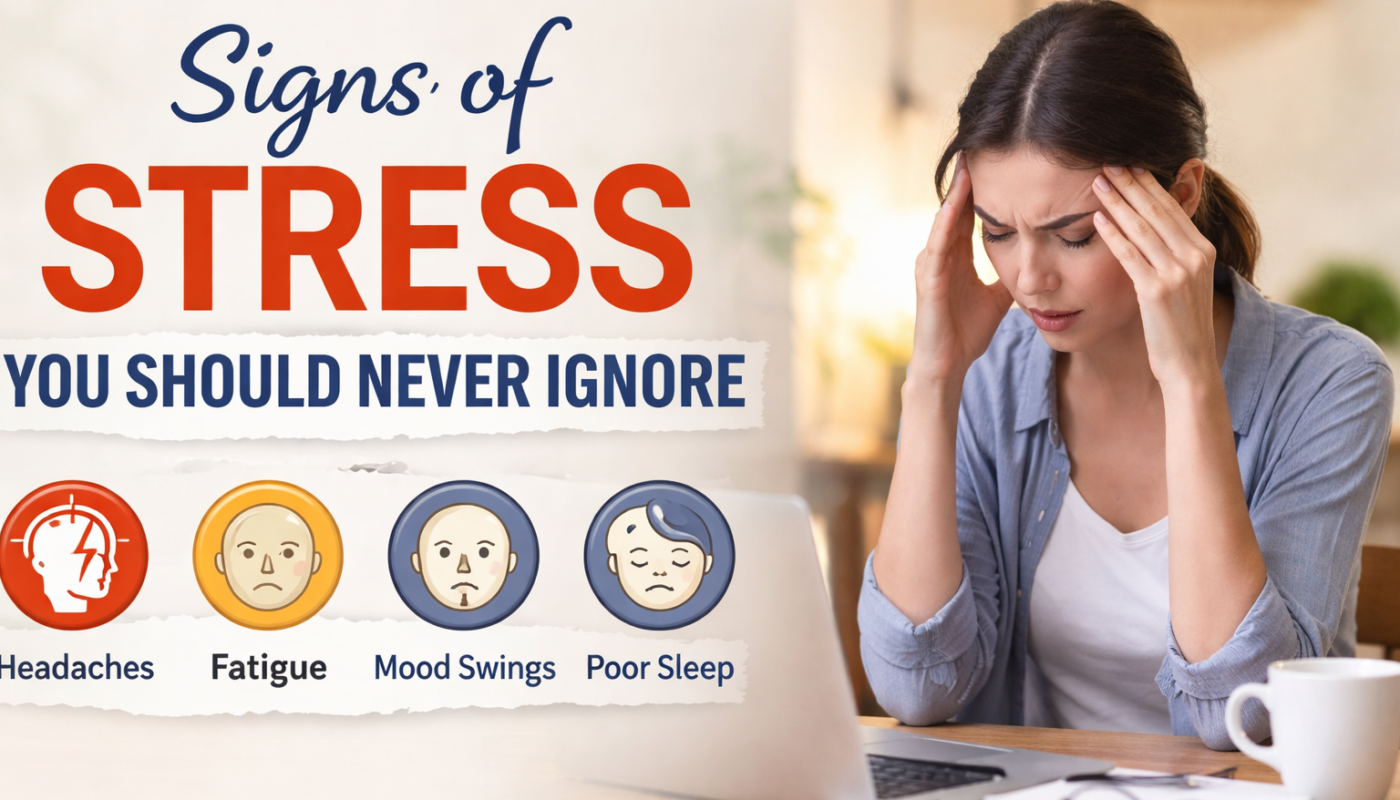
This guide unpacks the Stress Signs You Should Never Ignore, not as textbook symptoms, but as lived signals—clues your body and mind use when words fail.
Table of Contents
ToggleIntroduction
Stress does not always arrive as panic or breakdown. More often, it seeps in quietly, like sand in a shoe. At first, it’s uncomfortable. Eventually, it becomes painful.
Modern life rewards endurance. We praise pushing through exhaustion, normalizing sleepless nights, and swallowing emotions. Yet the body keeps score. When pressure overstays its welcome, it leaves footprints—physical, emotional, and behavioral.
Recognizing stress early is not a weakness. It’s literacy. And literacy saves energy, health, and time.
Physical Signs of Stress
Your body speaks first. It always does.
Headaches
Stress-related headaches feel different. They wrap around your skull like a tightening band or pulse behind the eyes after long mental strain.
These headaches often appear after prolonged concentration, unresolved worry, or emotional suppression. Painkillers may dull the ache, but they don’t address the origin.
Try this: pause every 90 minutes, unclench your jaw, drop your shoulders, and breathe slowly through your nose. Small resets interrupt the stress cycle before it hardens.
For deeper insight, the Mayo Clinic explains how stress influences chronic headaches:
https://www.mayoclinic.org/diseases-conditions/stress/in-depth/stress-symptoms/art-20050987
Fatigue
This is not ordinary tiredness. This is bone-heavy exhaustion—the kind sleep doesn’t fix.
Stress fatigue drains motivation, fogs thinking, and turns simple tasks into uphill climbs. You wake up tired. You move through the day half-charged. Even rest feels unrefreshing.
When your energy vanishes without physical exertion, stress is often siphoning it behind the scenes.
Muscle Tension
Notice your neck. Your shoulders. Your lower back.
Chronic stress keeps muscles braced, as if danger is imminent. Over time, this constant contraction leads to stiffness, soreness, and reduced mobility.
Stretching helps, but awareness helps more. Each time you exhale, consciously soften one muscle group. The nervous system learns through repetition.
Emotional Signs of Stress
Emotions distort before they explode.
Mood Swings
One moment calm, the next irritable. Laughter flips into silence. Minor inconveniences feel monumental.
Stress shortens emotional fuse length. It hijacks regulation, making reactions sharper and recovery slower.
If people close to you say, “You don’t seem like yourself,” listen. They may be seeing what you’ve grown accustomed to ignoring.
Anxiety
Stress and anxiety often travel together, though they are not identical.
Stress plants the seed; anxiety waters it. Thoughts race. Scenarios spiral. The mind rehearses disasters that never arrive.
You may feel restless, on edge, or unable to relax even in safe spaces. This is your nervous system stuck in high alert.
The Anxiety & Depression Association of America offers grounded explanations and coping tools:
https://adaa.org/understanding-anxiety
Irritability
Irritability is stress’s sharpest edge.
Sounds feel louder. Conversations feel heavier. Patience evaporates without warning. You may snap at people you care about, then regret it moments later.
This isn’t a personality flaw. It’s emotional overload leaking out sideways.
Behavioral Signs of Stress
Behavior reveals what words conceal.
Overeating or Undereating
Stress disrupts appetite signals. Some people graze constantly, seeking comfort through texture and taste. Others lose interest in food altogether.
Neither extreme is about hunger. Both are about regulation.
If eating patterns shift suddenly—without conscious intent—stress is often steering the wheel.
Isolation
Withdrawing doesn’t always mean loneliness. Sometimes it’s self-protection gone too far.
You cancel plans. Messages pile up unanswered. Social interaction feels draining rather than nourishing.
While solitude can heal, chronic isolation deepens stress by removing support systems when they’re most needed.
Poor Sleep
Stress sabotages sleep with ruthless efficiency.
You lie awake replaying conversations. You wake at 3 a.m. with your mind sprinting. Or you sleep long hours yet wake unrested.
Sleep disruption is one of the clearest stress signs, and also one of the most damaging if ignored.
When to Seek Help
There is a difference between coping and enduring.
If stress begins to interfere with daily functioning—work, study, relationships, or health—it’s time to reach out. Not because you failed, but because pressure exceeded capacity.
Seek help when:
-
Symptoms persist for weeks
-
Sleep remains broken despite lifestyle changes
-
Emotions feel unmanageable
-
Physical pain has no clear medical cause
Talking to a counselor, doctor, or trusted mentor can recalibrate your system. Early support prevents deeper collapse.
The World Health Organization outlines when stress becomes a health concern:
https://www.who.int/news-room/questions-and-answers/item/stress
Conclusion
Stress does not need to ruin your life to deserve attention. It only needs to whisper long enough.
The Stress Signs You Should Never Ignore are not dramatic warnings—they are quiet negotiations. Your body and mind are asking for adjustment, not surrender.
Enjoyed this article?
Share it with friends, bookmark this page, and visit again for more helpful fitness and health tips.
Notice the signals. Respond early. And remember: managing stress signs is not about eliminating pressure, but learning when to loosen your grip. Your well-being is not a luxury. It is infrastructure.